NYC ABC, along with several other individuals and prisoner support crews, now send hard copies to all political prisoners and prisoners of war we support.
If you consistently mail the latest updates to a specific prisoner, please let us know so we can insure there’s no overlap. The goal is to have copies sent to all of the prisoners we list.
We’ve also been told that some prisoners are not receiving the copies sent in, yet we aren’t getting rejection notices. If you are in steady contact with a prisoner, please ask them whether or not they are receiving the updates and let us know.
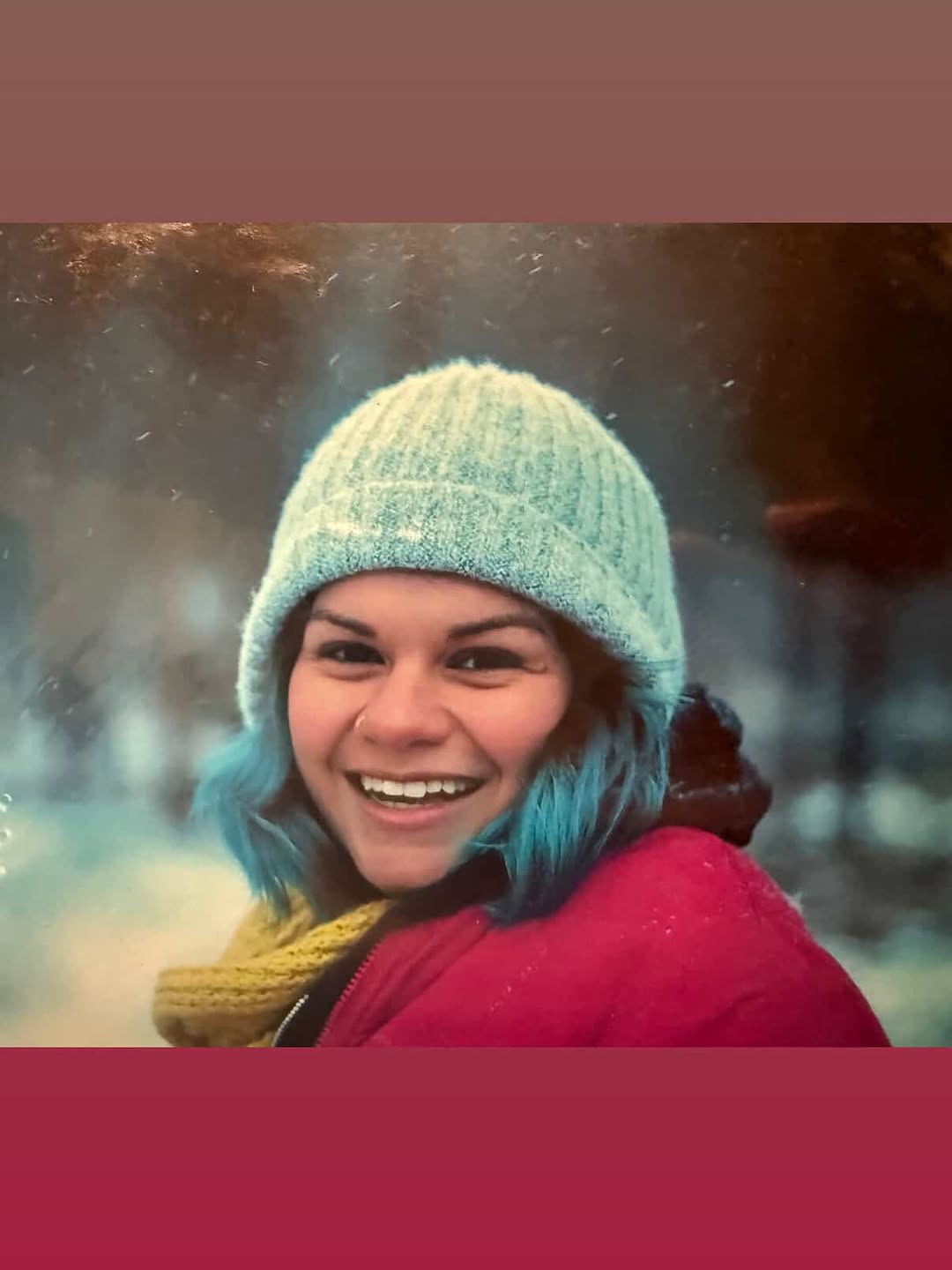
Casey offers here their reflections on the recent book drive they organized for the prison library, its popularity with everyone locked up, as well as how it has since been blocked and how Casey subsequently was fired from their library job. Please share and repost. – Casey Support Committee
AFFIRMATION
Thank you to everyone out in the so-called “free world” for contributing to our Summer Book Drive. On behalf of the Support Committee and every convict at FCI Allenwood Medium involved in this autonomous initiative, we send our revolutionary love and profound gratitude. From this self-organized prisoner initiative, we introduced a wide range of new, interesting, and relevant books into the prison’s official library collection. During my time as a library worker, many significant changes were made to the form and content of the library here at Allenwood Medium. Unfortunately, because of the Book Drive’s budding success and overwhelming popularity among the captives, i was fired from my job as librarian last week.
TERMINATION
On Thursday, October 1, i was fired as a library worker at FCI Allenwood Medium prison for no reason other than “ordering too many books” and “donating them directly into the library catalog” without the approval of the Education Department Supervisor, Mr. Williams. Although my boss, Ms. Ashton, knew about the plans for a mass donation and granted permission to do so, i was thrown under the bus once she learned her boss found out, and especially once she learned i was adding certain books into the catalog without her approval. There is nothing against policy within the books that were donated, even the ones i donated without Ms. Ashton’s knowledge. The Book Drive was successful in adding around one hundred brand new books to the library catalog, which transformed the library space from a realm of entertainment and distraction into one of pedagogy and critical study. By the first week of September, around seventy more books were delivered to the mailroom, yet staff deliberately let them pile up, before complaining to admin about the quantity of donations and returning them all back to sender. A few days later i learned of my termination.
It’s the overwhelming pettiness of the reaction that bothers me. There is no BOP policy that states we as prisoners cannot donate books into the library collection. There is an official process to do so however and i bypassed some of the red tape. Yet the only violation of policy i am “guilty” of is not showing my boss, Ms. Ashton, every single book that i was donating. My decision to not report donations wasn’t at all due to any intentional plot of deception. It was simply because whenever i gave my donations to Ms. Ashton, she would “never get around” to adding them into the catalog. They would just sit around and often disappear. I was frustrated by Ashton’s lack of enthusiasm regarding this rare opportunity to enhance the library collection, so i decided to just start marking, labeling, and cataloging the books myself. Basic direct action.
ACTION/REACTION
All who were involved in the Summer Book Drive (not only me as an individual) took direct action both to remedy the negligence of the correctional officers who oversee “education” operations at Allenwood Medium and to counter fascist anti-intellectualism, of which the official indifference to our depraved learning conditions is symptomatic. I am not exactly sure how the process occurred behind the scenes, but apparently a mailroom officer (who does not like me) contacted S.I.S. (the surveillance and investigative wing of the prison administration), who then contacted Mr. Williams, who in turn emailed Ms. Ashton ordering my termination as a library employee. I believe that the primary reason i was fired was politically motivated censorship, coupled with the fact that some of the COs already had an issue with me working in the library.
My termination as a library worker demonstrates how the administration at FCI Allenwood Medium will attempt to stifle any act of autonomous sufficiency and self-organization among us convicts, especially if activities aim to improve the conditions of life. The Summer Book Drive initiative was not only an attempt to counter the dehumanizing conditions of a neglectful Education Department but a demonstration of collective action to provide and (re)distribute resources in the face of (or rather in spite of) organized abandonment. Inadvertently, the initiative also illuminated a potential collective capacity that exists between concrete people across prison walls. Within a matter of weeks around 200 books were donated through a public wishlist. What other outcomes might result from a similar constellation of autonomous, informal organization? The purpose of this reportback, however, is not to address this question in particular. That must be the topic of discussion elsewhere. For now, i just want to catch everyone up to speed and explain just how the Summer Book Drive unfolded, and how our work in the library was demonstrably changing the atmosphere of learning in this prison.
REPORTBACK
When i arrived at FCI Allenwood Medium back in February, i was appalled by the lack of resources provided by the Education Department’s “library.” Barely any of the books were visible on the shelves. The shelves themselves were behind a desk, so no patrons could walk up and pull a book on their own. The content of the library catalog was almost entirely fiction, and none of the scarce non-fiction texts were visible at all. In fact, i was told by my boss Ms. Ashton that “this bunch are more of the fiction, fantasy kind of guys” — an assumption proven completely false once i conducted a survey and began offering fellow prisoners non-fiction books with social, cultural, and historical relevance. From what i’ve gathered, the library at Allenwood Medium is by far one of the worst libraries in the Federal BOP. The more time i spent in the library, i became intimately attentive to the inadequacies and intricacies of why this alleged library earned the reputation of “worst of the worst.”
In June 2026, when i was hired as a librarian, i began conducting a survey of each “car” in my unit and then across the entire compound, researching what the most popular books are among prisoners at Allenwood Medium. (For those who don’t know, “cars” are how we are collectively organized, prisoner-to-prisoner throughout the BOP; i.e. the Midwest Car, White Car, Gang Cars, Pennsylvania Car, and so on.) I made sure that all races and religious affiliations were considered in this survey, and i consolidated the results to a list of around 100 specific books, as well as dozens of authors, publishers, and topics of books that prisoners desired to read at this facility. From there my support committee and i created a wishlist derived from the survey findings and circulated the wishlist publicly using the incredible www dot bookshop dot org. The idea was to use the social platform that my support committee has worked so hard to maintain over the past two and a half years to organize a SUMMER BOOK DRIVE, where people on the outside can purchase the requested books from the public wishlist. The books then were to be delivered to me, which i would donate directly into the library collection.
As the Book Drive began, i was already involved in the process of rearranging the library stacks by subject and genre and had the support of Ms. Ashton to do this. In fact, she initially welcomed my consistency and enthusiasm. For FICTION i divided up the shelves to hold (with visible labels) ‘Fantasy’, ‘Western’, ‘Science Fiction’, ‘Thriller & Suspense’; ‘Mystery & Crime Drama’, ‘Deep State Fiction & Political Drama’, ‘Military Fiction’, ‘Historical Fiction (Modern)’, ‘Historical Fiction (Pre-Modern)’, ‘Historical Fiction (20th Century)’. As time went on my plan was to also create an section of the library for ‘Urban Novels’ and ‘African American Classics’. For NON-FICTION, i made the existing books in the library visible to patrons for the FIRST TIME EVER and then created various subject categories such as ‘US History (Pre-20th Century)’, ‘US History (20th-21st Century)’, ‘World History’, ‘Social Studies’, ‘Native Studies’, ‘Science & Nature’, ‘Geography’, ‘Music, Film, & Pop Culture’, ‘Sports’, ‘Health & Fitness’, ‘Business & Marketing’, ‘Self-Help’, ‘Survival & Uplift’, and ‘Resume & Job Search Resources’.
As i described above, around 100 books were successfully delivered to me. After receiving what books the mailroom *did* allow, i added those books into the library catalog. By “adding into the catalog,” i mean that my coworkers and i stamped, stickered, added check-out cards in the books, and shelved them. The feedback from fellow convicts regarding the Book Drive was wildly supportive and positive without a doubt. As the library collection progressed, regular patrons who entered the library would comment on how much better the selections were; how much easier it was to find books; how they felt more interested in going to the library; and most of all, i noticed a substantial interest in the non-fiction sections, especially Social Studies, US History, and Native Studies. The number of nonfiction books that patrons checked out increased markedly. Most importantly, in the days leading up to my termination, a new spirit of critical study and discussion seemed to be permeating the library and its users.
I have to remind myself that there is only so much you can do without greater organization of opposition to the prison regime from within and without. I am chalking this up as another experience, or maybe, rather, the marking of a new chapter in the Campaign Against Prison Censorship and Book Banning [ see https://trueleappress.wordpress.com/2023/04/13/new-zine-campaign-against-prison-censorship-and-book-banning/ ]. I’m not sure what my next moves will be, but one thing is for certain: There’s a growing number of convicts in this prison who desire a deeper grasp of the world beyond the false sense of “participation” shoved upon us by the TV screens, corporate newspapers, radio shows, remedial programs, and commercial-distraction novels sanctioned by the Federal Bureau of Prisons. The Book Drive could be blocked but the information that such literature instills in our convict class is something that fascists can never return to sender. One idea that my celly had was to simply order books on anti-prison activism, abolition, and prisoner movement history for every prisoner at FCI Allenwood Medium. All of our information is public access on the BOP website. Just pick a name on the BOP “Inmate Locator” and order a book. Brilliant!
Ever more obvious is the substantial mass of people beyond the wall in the so-called “free world” who are impacted by the regime and continue to express a desire to participate in collective anti-prison resistance. These are people actively searching for opportunities to support their own loved ones and others in captivity. As Ruth Wilson Gilmore writes in her 1999 article ‘You Have Dislodged a Boulder’, by “organizing surplus labor into cages,” the state pulls our loved ones, especially mothers and other caregivers, into its “spheres of operation.” The regime’s gravitational pull on our families and communities creates opportunities where our people can find each other and cooperate together *against* the state’s interests. Gilmore writes, “The magnitude of imprisonment suggests the magnitude of possibility”; and that magnitude “starts small, over and over again.” The scale and dynamic capacity of formal and informal prisoner-support structures put on display by the Summer Book Drive suggests the embryo of such possibility. I know if i were on the outside right now, i would be dreaming and scheming of where to take this collectivity next. I send my blessing for anyone reading this to do the same. After all, it’s one struggle at base.
To write Casey: Casey Goonan #24611-511 FCI Allenwood Medium PO BOX 2000 White Deer, PA 17887
Chicago Police Attack the Marathon and Generator Show Seizing Equipment and Arresting Four
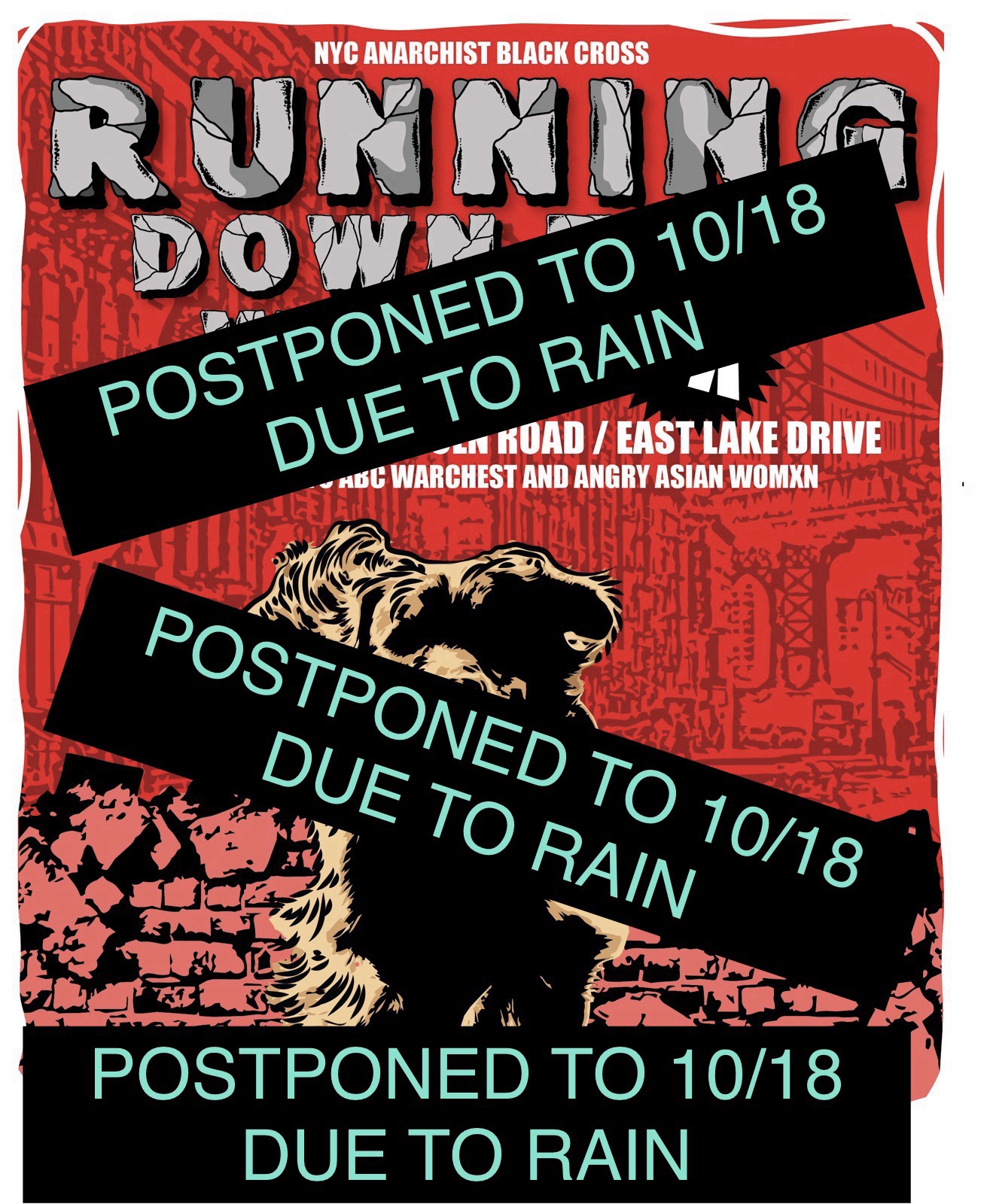
On Saturday the 19th of September, chapters of the Anarchist Black Cross Federation (ABCF) on occupied Turtle Island held the annual Running Down the Walls (RDTW) non-competitive solidarity 5K marathon and fundraiser event. Each year people hit the concrete both inside and outside prisons for a collective run, walk, roll and march towards freedom for political prisoners and the abolition of prisons. RDTW is also the primary yearly push to raise funds for the ABCF Warchest which each month puts money on the books of political prisoners/prisoners of war to help with commissary, communications and other financial needs. This year Running Down The Walls events were held in Los Angeles CA, Bloomington IN, Philadelphia PA, Brooklyn NY, Kingston NY, Ft Lauderdale FL, Lowell MA, Eugene OR and Chicago IL.
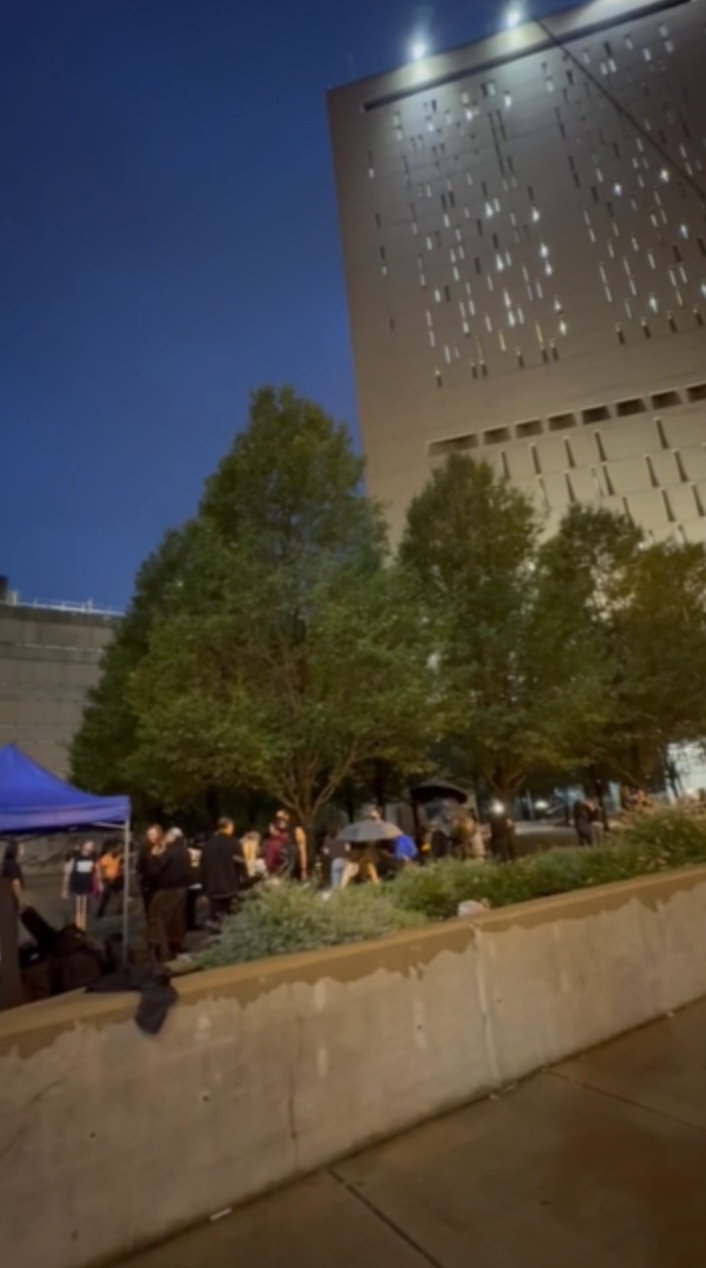
This year’s Chicago RDTW descended upon the federal Metropolitan Correctional Center (MCC), a brutalist downtown skyscraper imposing harshly upon an otherwise pleasant tree-laden plaza that had until recently been fenced off from protesters and people looking for a place to hang out in public. MCC is also kitty-corner to the ICE Field Office as well as State Department and U.S. Citizenship & Immigration Services offices. This was the second year that RDTW was held at MCC, also the site of occasional noise demos, but is not subject to nearly enough attention considering all that has happened at the hands of the feds in Chicago and elsewhere this past few years.
The federal Bureau of Prisons holds our comrades captive in a dehumanizing destitute existence that has only increased in cruelty as the Trump Administration weaponizes the DOJ against immigrants and resistance movements. It’s been a hard year of escalating fascist repression: militarized stormtroopers rampaging neighborhoods to kidnap undocumented people into networks of imprisonment and deportation, the targeting of dissent as “terrorism” with manufactured federal conspiracies and lengthy sentences, increased repression of political prisoners behind the walls, and even the criminalization of zines and blogs. If prisons are escalating, so must we; as long as our comrades inside are fighting, know that we will also take the struggle to the front gates. We also do it a bit different in Chicago; for the sixth year in addition to the rally march and marathon we planned a generator show with bands and DJs blasting punk, hip hop, and techno right outside the prison walls so the people held inside can enjoy, dance along with us, and know we got their back.
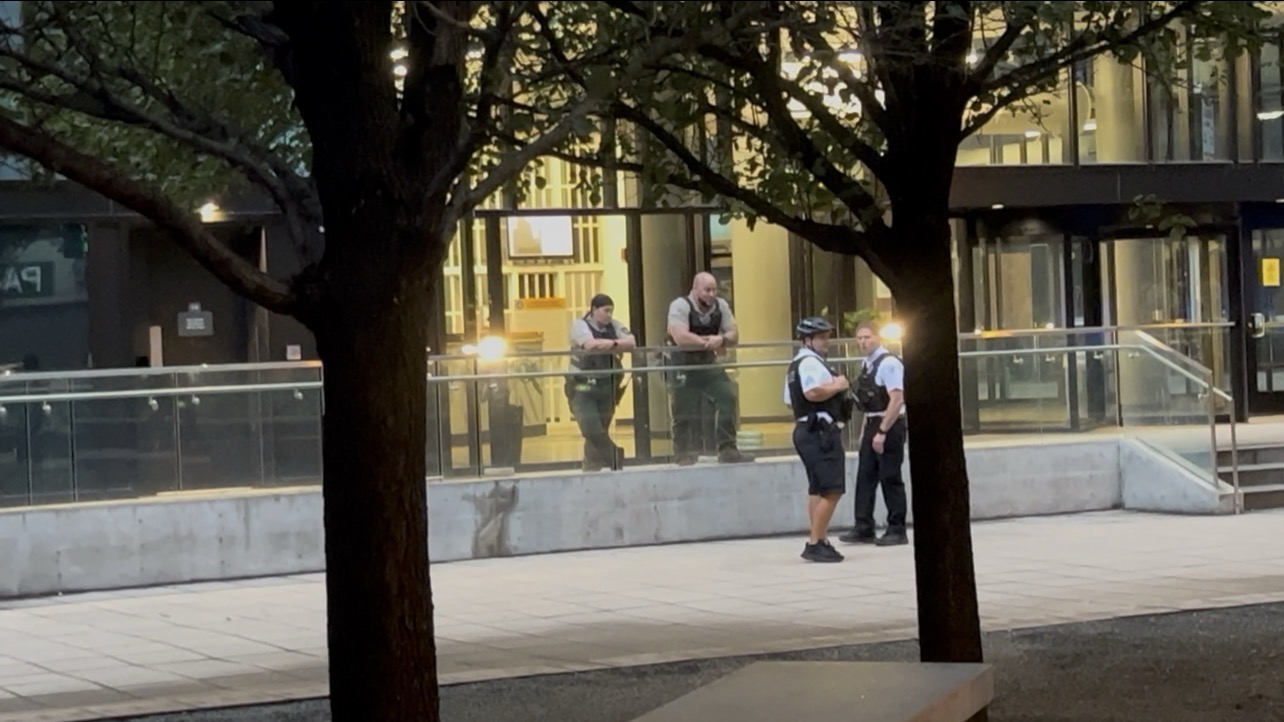
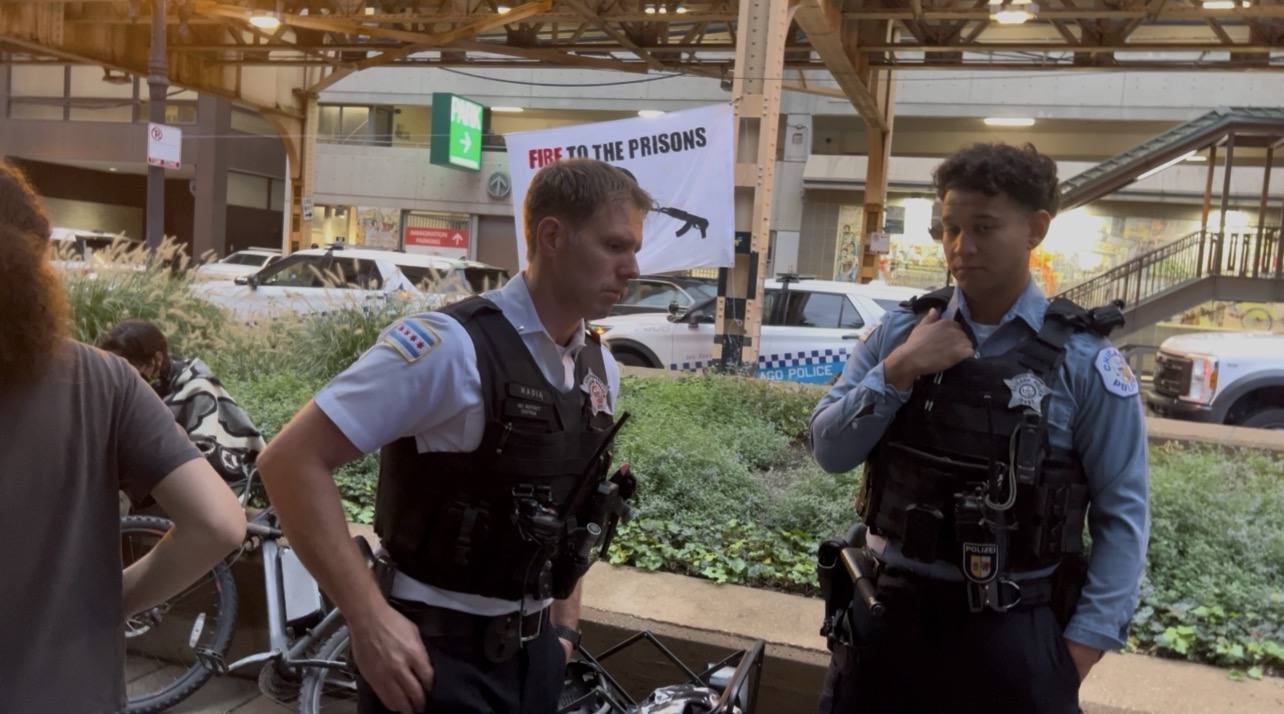
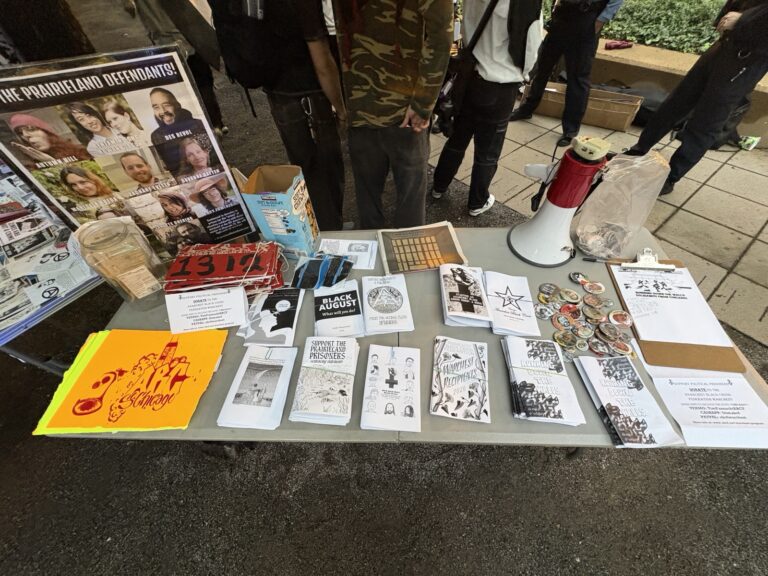
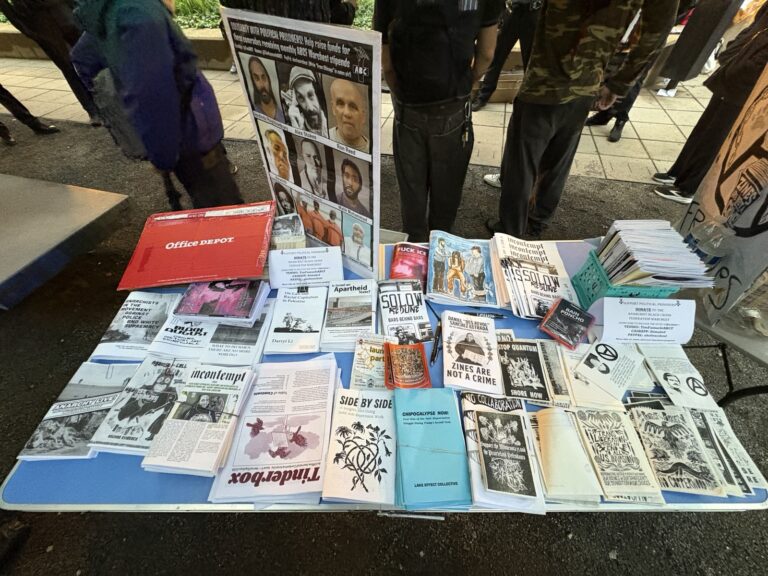
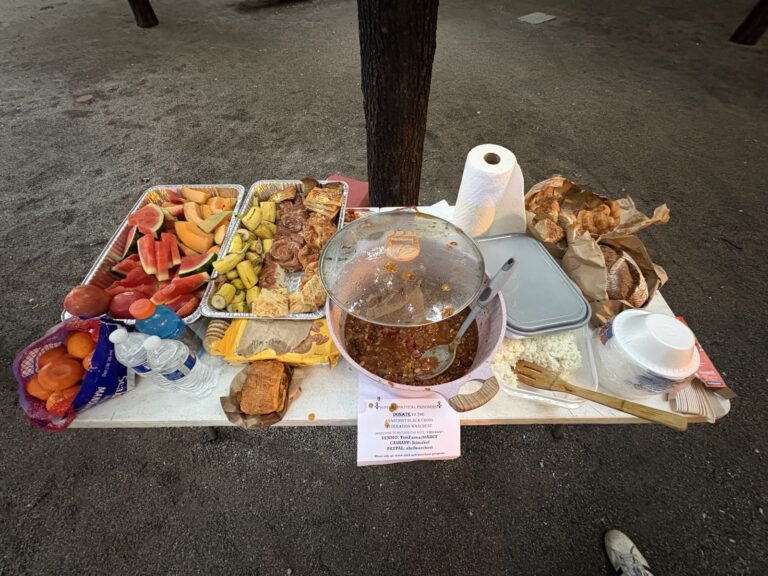
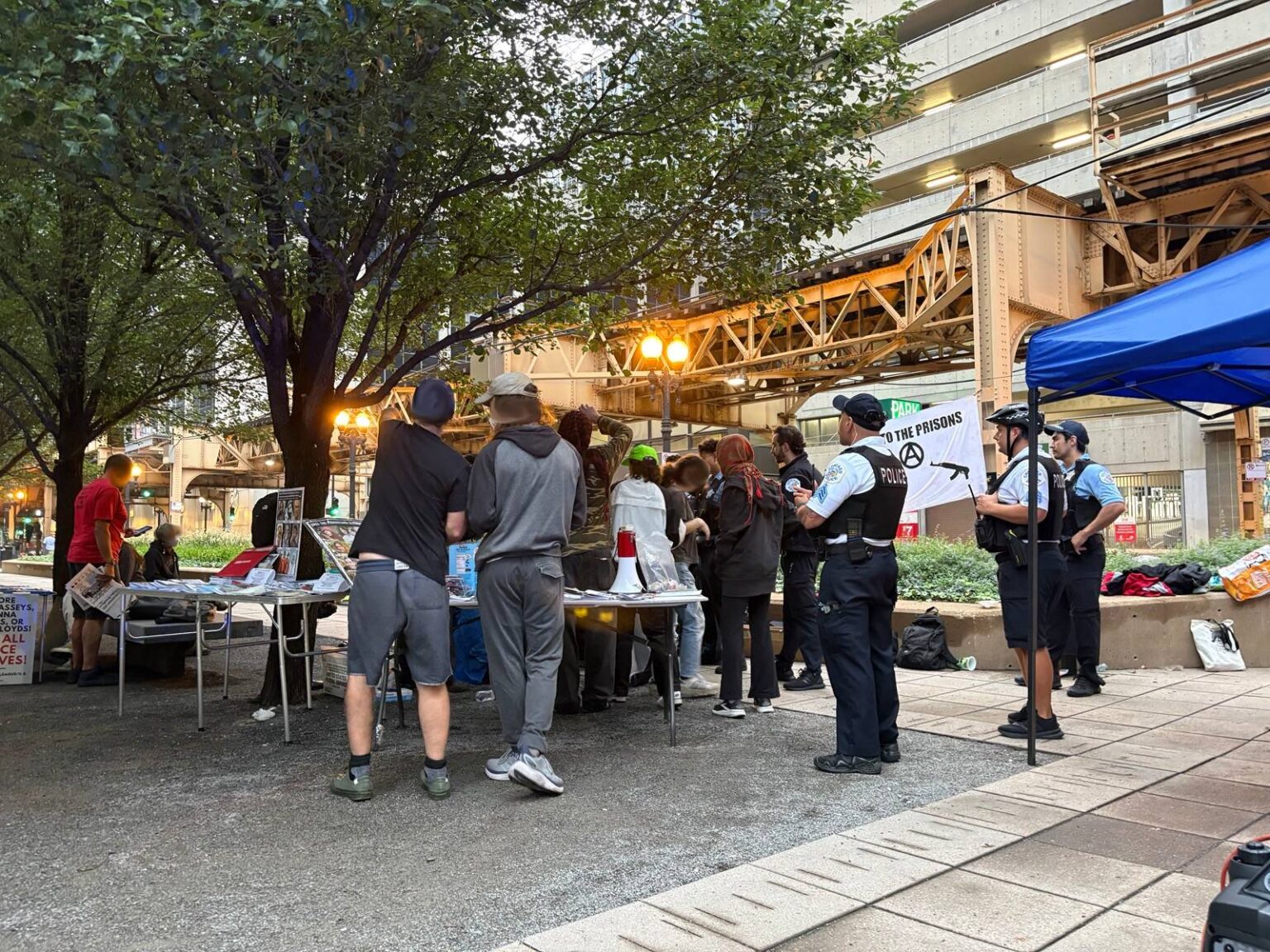
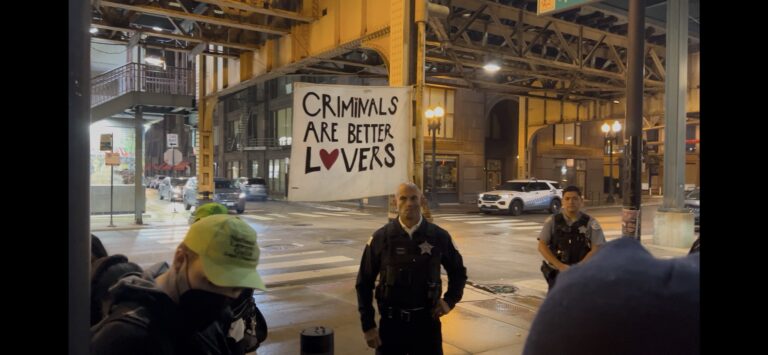
As people took to the plaza hanging banners and setting up tables for zines and food, almost immediately the Chicago Police Department arrived and began intimidating the crowd with threats of arrest and violence over the unpermitted gathering and the mobile soundsystem. Of course we never need or seek permission from the state to gather in public, but the MCC and the park in front of it is federal property under the proclaimed jurisdiction of the Bureau of Prisons (BOP). Local, county, and state police continue to work on behalf of federal agencies, not only BOP. Illinois State Police, Chicago Police and others have coordinated with the feds to spy on anti-ICE organizing and provide security stabilizing the federal kidnapping apparatus outside Broadview and throughout the state (much like outside Delaney Hall or MDC Los Angeles and so on)– despite the so-called “TRUST Act,” a reform meant to protect the image of local and state police from being linked to immigration enforcement. So not surprising it was dozens of CPD who pulled up menacingly with the white shirts arguing about federal noise regulations on the plaza after having met with the feds inside the jail. After resisting the initial barrage of police threats and reclaiming the park, the rally began defiantly reading the statements and recordings that political prisoners prepared for the event.
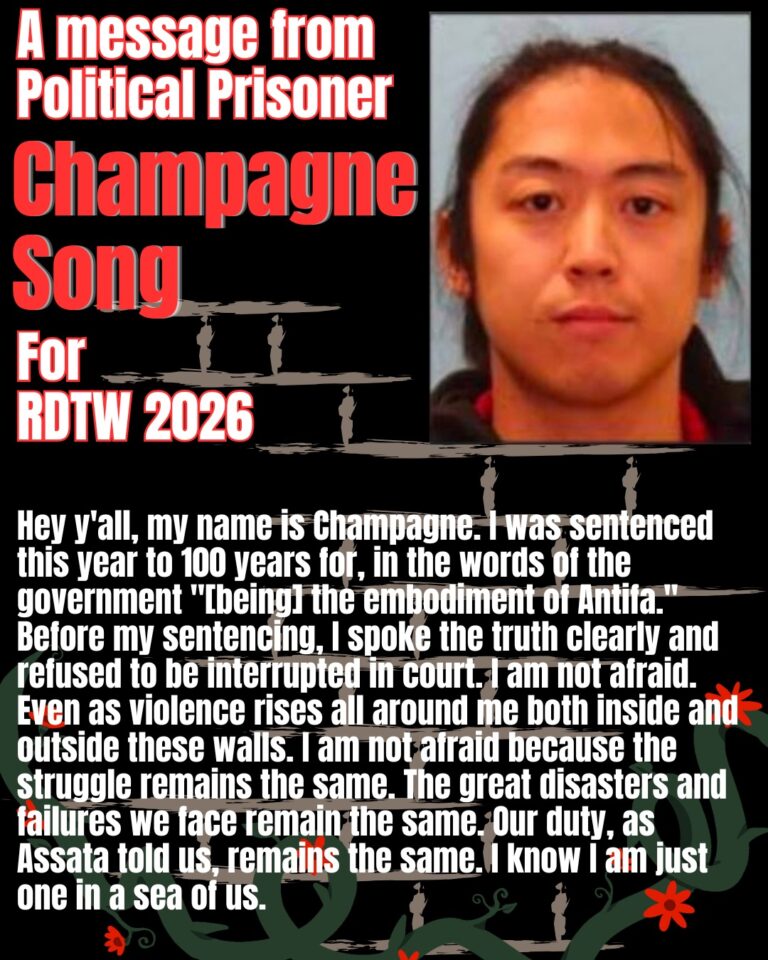
Champagne Song called in to read their statement and conversate with the people, reminding us that we are a sea that is unstoppable, that we will win; an encouraging confidence in our collective strength standing in front of a building that will not exist in 100 years, the sentence Champagne received for showing solidarity outside the Prairieland detention center: it is our every intent collectively that we will free them and the rest long before they’ll have to do those decades.
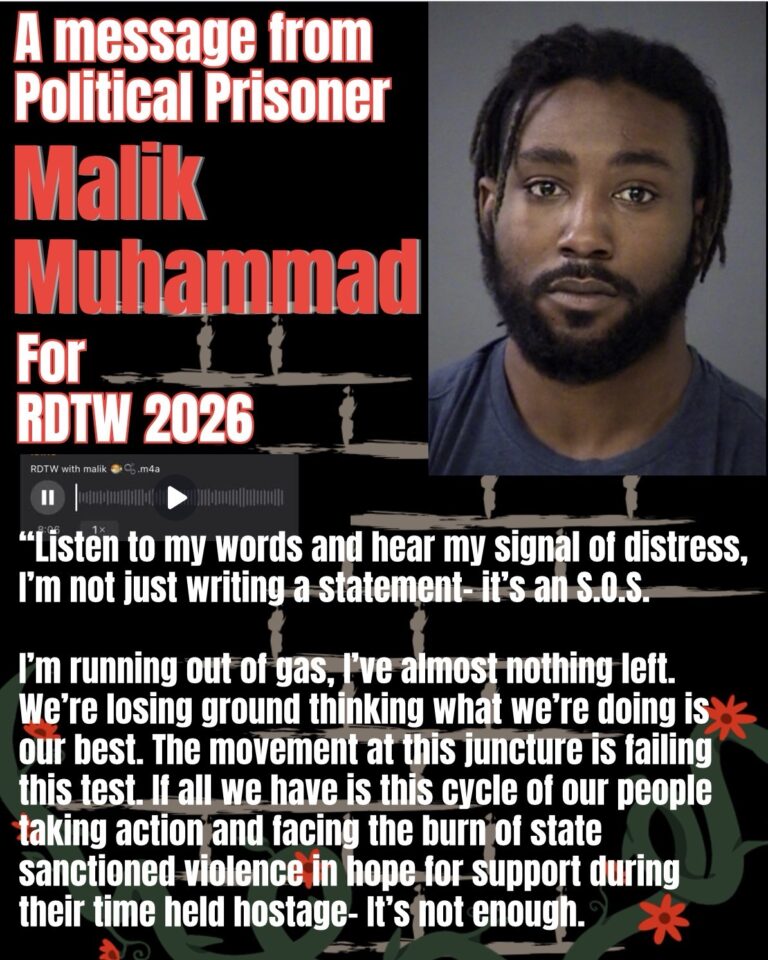
A recording of Malik Muhammad’s statement was then played unsettling the comfort of our action through a challenge to movements for prisoner solidarity, never losing sight that we will not run down these walls without tanks and the material means to tear away the cages that separate our kin. We continued with statements from Oso Blanco, Peppy, and Bill Dunne that running down these walls is an act of radical solidarity with tangible material consequences for those inside. A poem was read written by Ashley Wildfire, a participant in a group of RDTW runners this year inside Coffee Creek prison in Oregon. Dwayne “BIM 365” Staats from the Vaughn 17 uprising requested we play his recently released single “Liberation the new High”, speakers blasting revolutionary music from behind bars to the chagrin of the police who remained circled around the plaza.
After closing the rally out with a few announcements of other local projects, dozens began the 5K’s first lap around MCC marching together behind the “Running Down The Walls” banner, mobile soundsystem blasting. The march took Ida B. Wells Drive heading West momentarily shutting down traffic directly in front of the ICE Field Office. On the return down Clark Street, CPD bike cops caught up and tried, unsuccessfully, to push participants onto the sidewalk. Returning to the plaza in front of MCC, the rest of the marathon kicked off with a countup to “Fuck 12” and completed the run in small groups and individuals finishing the remaining six laps of the 5K. Throughout the evening participants could hear people from inside MCC loudly rapping on their thin windows echoing down to the street and plaza below below while others flashed their cell lights. Their agency was palpable throughout the night, a reminder to participants how fragile the space between inside and outside is and how we can break the contradiction by showing up outside and running together (as well as building relationships for long term support through letter writing, court support, publishing, phone zaps and other work of the ABCF)
As evening turned to dusk the DJ set kicked off, the crowd grew despite some rain, and the other artists began to prepare their keyboards and drums. Several dozen CPD began amassing and threatening the crowd again: after a police lieutenant proclaimed that any musician who performed would have their equipment confiscated and risk arrest, a heated debate was held with regard to the volume of a keyboard in a last ditch effort to save the show, but the white shirts were not budging. As they aggressively tried intruding, participants formed a line and linked arms to protect the space; bouncy techno continued loudly from the mobile sound system. The impasse stabilized a bit or so we thought as the white shirts were now saying the level of sound still playing was acceptable; still, people began considering a backup plan to move the show to a well-known outdoor show spot (which ultimately would have been a bust anyways as it began torrentially raining an hour later); however, the cops were making plans of their own.
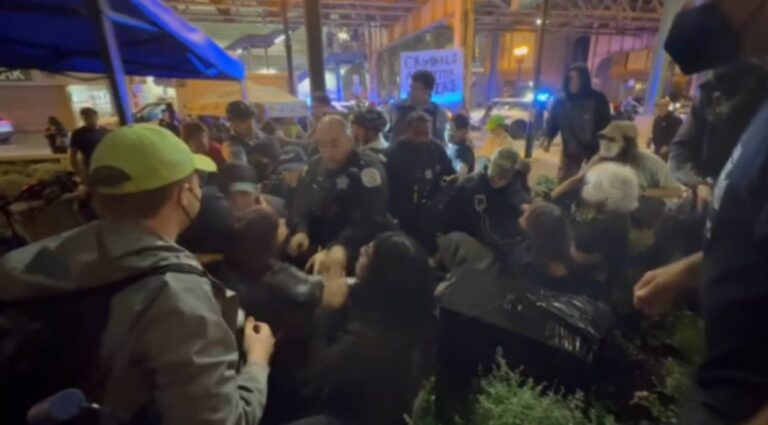
Without warning or orders of dispersal, two groups of cops sneakily flanked from the side and the back of the park grabbing the mobile sound system, beginning a tug-of-war that drew more people in from all sides until a full-blown cop moshpit ensued. Dozens of cops, outnumbered, quickly tired themselves out and pulled back, eventually satisfying themselves with arresting four people they targeted during the fracas – though the courageous efforts of those in the front helped to prevent many others from being snatched up. Angry at the cops’ dirty sneak attack, the people stood up to the cops and chanted “FREE THEM ALL!”, raising the spirits of the comrades held in the dozens of police cars and trucks lighting up the spectacle in front of the federal jail.
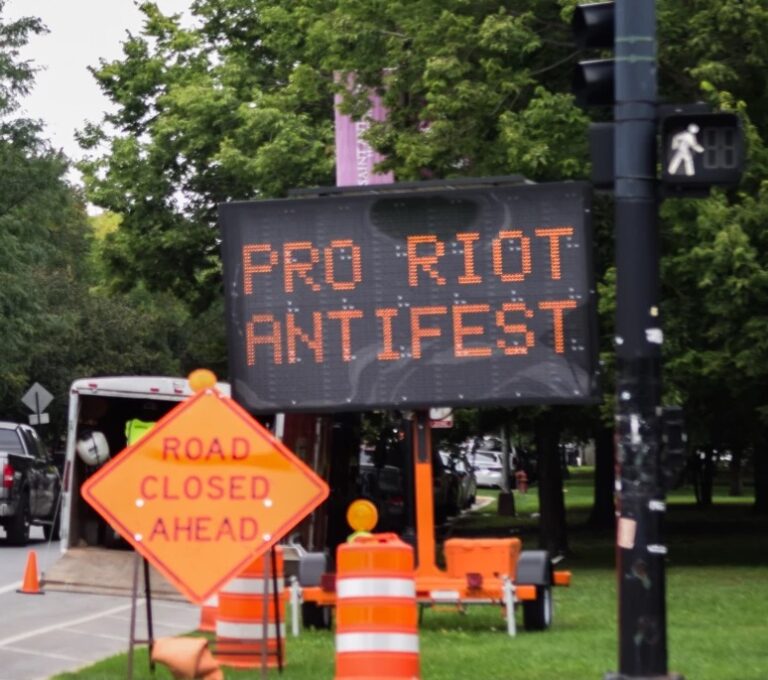
As the dust was settling, the rain started pouring, and people checked in on each other, gathered the gear and organized jail support. All arrestees were out within 24 hours, but four still face a misdemeanor resisting arrest charge. The rest of the bands and performers couldn’t play, but people still felt pretty good about how it went down, largely owing to what one participant called “the furious love and support everyone out there (not the cops) showed each other”. Could have thrown a chill fundraiser in a park or DIY space yes, but sometimes, and especially now, the underground must surface make a stand and take action. As “Riot Fest” festival gentrifiers were destroying Douglass Park, the real riot fest goes down when punks seek no permits, take the pit to the streets and fight the system.
The attack on RDTW is not an exception but another all-too-common example of the state’s reification of all space as governable through police enforcement. The settler project is intimately bound with how space is organized, and any act that transgresses such rigidity is met with violent force. The heightened policing and criminalization of Black and Brown youth in the teen takeover movement further demonstrates this paradigm: conservative aldermen call for “snap curfews” and increased policing while they sell off public parks to Riot Fest and hassle people selling water outside, running off street musicians and unlicensed vendors; the cops even stopping people waving Mexican flags out their cars during Mexican Independence Day. Many of the same cops who attacked RDTW just days later brutalized and arrested people for simply drinking lemonade in public, nevermind the city salt trucks blocking protests off from ever going north of the river or outside Trump Tower. The space of downtown Chicago is reserved for the ostensibly white, masculine, capitalist class, while Black/Brown youth who righteously defy the city’s deep segregation are subjected to not only increased surveillance and violence, but also subjugated to liberal conceptions of morality which say they do not belong. In this the public space becomes legible as space defined through colonialism, genocide, ethnic cleansing, slavery, segregation, and of course the prisons, detention centers, and jails.
With this understanding, Running Down The Walls then is, first, an act of solidarity with longterm political prisoners and prisoners of war whose personal efforts and sacrifices attack and delegitimize the colonial production of racial capitalism and the spatial arrangements it necessitates. Second, RDTW is itself an act of confrontation against the rigidity of space – the understanding that the jail should not be approached by people from the outside unless deemed permissible by the strict bureaucratic scrutiny and surveillance of the state. By approaching the Bureau of Prisons’ plaza, participants defiantly negate the jail’s imposing facade, a zone materially and ideologically between the city and the jail, and run together with one another. The tapping of windows and the flickering of the lights by people held captive inside, and the chants, banners, and waving of people on the outside cross the real and imagined walls of separation to make contact. That this contact was fleeting, limited, and primarily ephemeral recalls Malik Muhammad’s words that running down these walls will not happen without the tanks. Our efforts cannot forget this, that means mean material, that prisons are war, genocidal war. This war has been furnished and polished by the genocide of Indigenous, Black, and Brown bodies, by slavery through dispossession and the abduction of Afrikan peoples that continues today through the police and prisons. CPD and BOP and ICE are the same slave catchers. Any action that approaches the prisons, jails, and detention centers should not forget that this is war.
For the destruction of prison society! Free all political prisoners! Free them all!
On July 4th, during a protest at the Prairieland Detention Center in Alvarado, Tx Maricela Rueda was arrested for speaking out against the injustices of the immigrant detention system. She is currently incarcerated for taking a courageous stand in defense of dignity and justice. Maricela has always been a tireless advocate for human rights. Maricela is a mother, a daughter, a sister, and a loyal friend. Her arrest has left her family facing sudden and overwhelming challenges. Maricela’s young daughter is now without her mother’s daily love and care, and her family must also manage her estate and responsibilities while navigating the uncertainty ahead. We are asking for your support to help ease the financial strain during this heartbreaking time. All funds will go directly toward caring for her daughter and managing the urgent needs of her household. Thank you for standing in solidarity with Maricela and those who love her.
We’ve finished the latest version of the NYC ABC “Illustrated Guide to Political Prisoners and Prisoners of War” and it’s available for viewing (and download) by clicking on the link below.
This update includes updated mini-bios, illustrations, and address changes for several prisoners. Unfortunately, this edition adds four of the non-cooperating Prairieland defendants–Rowan Gibson, Autumn Hill, Mari Rueda, and Champagne Song.
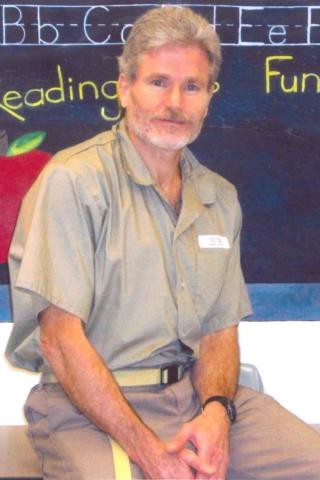
The agency of repression closed the yard for my contribution to RDTW, this weekend before the fall, 2026. The passage of time is revealing a rift between the concrete paving the small courtyards that remained open and the knees. The hamstrings and the ridiculously curved treadmills have a similar schism. So I rode an elliptical into the fray to Run Down the Walls. I let ’em have both legs three days and then again two days before the fall, 19 & 20 September. I had to do some slithering to access the venue the second day, but so it goes in life with big brother And the day before the fall, I write this report. Plus, I may have added one more means of motion to run down the walls: rowing. After my engagements on the ellipticals had ended, I wrestled the rowing machine to wring a few more gritty grains from the walls.
As my feet pushed ever forward and my arms aided and abetted, the elliptical didn’t carry me any where but figuratively. My forced presence in that physical moment, however, let me, made me, invited me me to notice the little drops of sweat hitting the concrete floor as they dripped off me. At first, just a few isolated individuals dotted the scuzzy gym floor–literal drops in the bucket, but without even a bucket. But the drops started coming in numbers, and their dots started running into each other. They started making bigger splats together than by themselves. They started to run together into a puddle. Not much of a puddle, but a puddle. Tiny ripples started to appear–and what is a ripple but a baby wave? Making waves in a social order like ours is always good. Some drops hitting the nascent puddle launched diminutive splashes, maybe reaching as far as the wall, where some of them eroded and ran off with some molecules of wall. Best of all, drops and splats and small ripples from the guy sweating on the next machine started running together with mine. Don’t know where he came from. Don’t know what car he rode in. But he was throwing down some work for a better future like I was. And our collective drops of sweat were conquering the entire floor.
May your Fall be a season of of connection, progress, and feeling good!
The future holds promise!
Bill Dunne 21 September 2026
Bill Dunne #10916 086 FCI Butner Medium II Post Office Box 1500 Butner, North Carolina 27509
Hey y’all, my name is Champagne. I was sentenced this year to 100 years for, in the words of the government “[being] the embodiment of Antifa.” Before my sentencing, I spoke the truth clearly and refused to be interrupted in court. I am not afraid. Even as violence rises all around me both inside and outside these walls. I am not afraid because the struggle remains the same. The great disasters and failures we face remain the same.
Our duty, as Assata told us, remains the same. I know I am just one in a sea of us. We are strong. We are smart and capable. We are committed. We will think and love and win. We will care for and protect each other. We will speak and listen, connect and grow. The better world we struggle for is our duty and our birthright. I will continue to fight for it. We will win it together. Thank you, each and every one of you. I am so grateful for the work and support of the ABCF and events like RDTW. Thank you for supporting us, supporting this, supporting yourself. I will see you when we are all free!
Listen to my words and hear my signal of distress. I’m not just writing a statement. It’s an SOS. I’m running out of gas. I’ve almost nothing left. We’re losing ground thinking what we’re doing is our best. The movement at this juncture is failing this test.
If all we have is this cycle of our people taking action, then facing the brunt of state-sanctioned violence and hope for support during their time held hostage, it’s not enough. If we can muster money for lawyers to negotiate our surrender and get them rich, these agents of the state, this is no better. If paying the state millions for our people to survive inside and communicate with loved ones is our best, our imagination is stunted. We cannot limit ourselves to the confines of the box the state has given us. We cannot work with the ones causing the problem, No! We must do more, do better.
Reaching into hell and pulling those the state has damned from the depths. This is no easy task, tattered, torn, burnt, and charred, one might get, but to break chains of bondage and defy those who would call themselves authorities of us and hold demean over us, it is worth it. To tell the state, No! you cannot have that one. You may not hold freedom’s son, daughter, brother, father, mother, wife, sister, none. None you may keep. For those you steal away, freedom we’ll pursue, to the depths of hell.
And this is hell. Each day we burn, licked by the roaring flames of the state, entombed in this concrete belly of the beast. Every day is a feat to survive. Every action the state takes against us is violence. These $6 phone calls, that should be $3, but because GTL is allowed to rape our families’ pockets, taxing $3 just to double that, that’s violence. The hell we endure goes beyond monetary exploitation, and it doesn’t matter what state you’re in. Under Nikki Haley’s stewardship, South Carolina only gives two meals on the weekends, brunch and dinner. The current Trump-backed candidate says “pack them four to a room and feed them roadkill”. A very moderate stance when you consider these penal colony death camps and what we endure, a slow genocide. It matters none where you are. Some have the audacity to say the federal prison is better or this state is worse. No. Hell is hell. A plantation is a plantation. Because bondage and slavery is bondage and slavery. Whether your plantation is akin to Toni Morrison’s sweet home depiction, or the antebellum super planters, or the ones that forced us to build railroads and trains bites and bridles in our mouths with the tacit threat of lynching for fun, or being strung up head over a fire to boil our brains – plantations are plantations as a death camp differed from a work camp only in how prolonged your death may be, your end is the same.
It doesn’t matter if you’re a political prisoner, politicized prisoner, or a victim of state-sanctioned poverty and circumstances that forced you into acts of survival they criminalized to ensure your demise. It’s a death march, a slow genocide. The end is the same whether you were shuffled into the gas chambers or the ones picking the bodies clean as bid by your captors. Choctaw, Cherokee, Navajo, or Apache, the state, violence, genocide, and subsequent seclusion on reservations by way of colonization in hopes you’d wither and die and disappear into the collective memory black hole of this fascist state is the same end. Prison, detention centers, reservations, work camps, death camps, plantations – all genocide. There’s no difference.
And if you recognize these as such and believe support is our best, then you do not overstand what we’re talking about. You listen, but don’t hear. You care, but don’t feel it. Being here to help isn’t the need, but recognizing this shit is killing you too, and fighting, is. Four people died in SCDC last week. One suicide, one heart attack, two other cancers. This menial food is poison. The conditions, hell. From here to Oregon, to Cali, Washington, New York, Illinois, these straights are dire, and we need action.
You will not be able to run down these walls without a tank, and noise demos aren’t explosive enough alone to open these cages. We can’t let this be the end for us. This cycle of action, criminalization, kidnapping, ransoming, negotiated surrender, and held hostage in the belly of the beast for decades in hopes for release. Abibifahodie means African liberation. Yohuru Sasa means freedom now. Not yesterday. Not in a decade. Sio. No. Sasa. Assata said “it’s our duty to fight and our duty to win””. Ushindi. Victory is the only outcome. But we won’t achieve Ushindi through the state’s allotted means. Only by burning and scorching our hands, digging deep into the pits of the earth, risking life, and limb can we pull out those the state tries to claim. Imagine the actions if our people knew that should they be caught and captured, this is not the end. Imagine if they knew they could evade capture and continue their action because the people got them.
The Underground Railroad smuggled people out of hell to what they thought was freedom, but only a different place than hell. Out of the frying pan and into the fire, but reverse. The Haitians had no illusion of a free north, their only recourse was liberation or death by any means. And that’s our state of being. Liberation or death. Not just for us in these pits licked by flames, but for you in the frying pan, who can be cast into the fire for anything, given the proclivities of the state. There is no free North, no freedom here in America, no innocence either. Everyone is a part of the problem, and everyone can be a solution too.
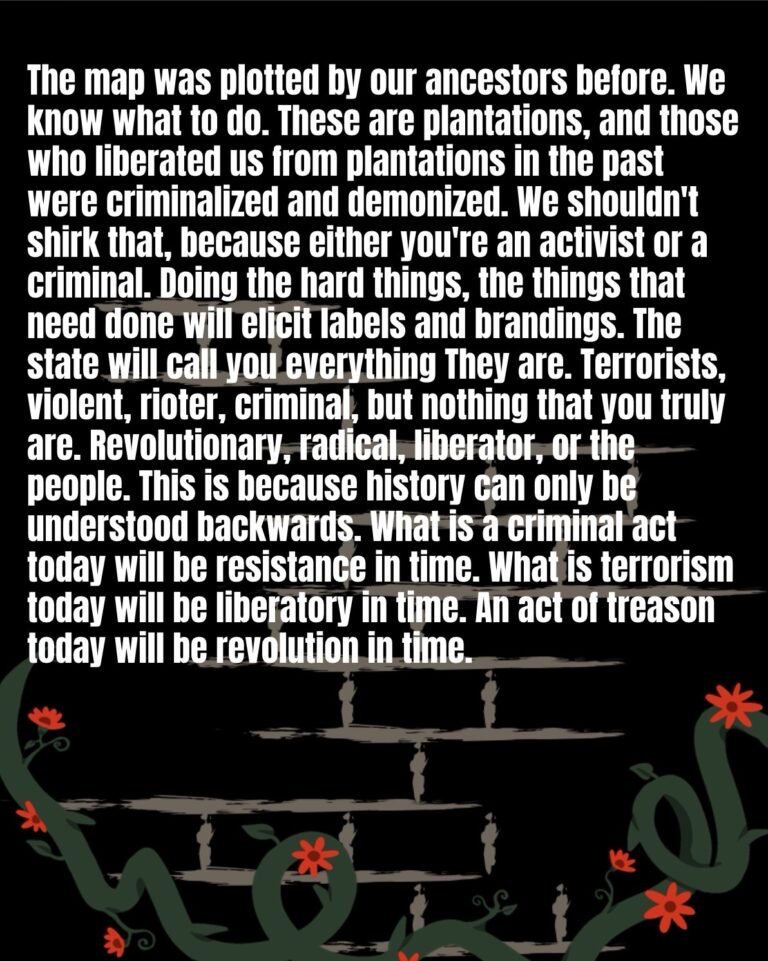
The map was plotted by our ancestors before. We know what to do. These are plantations, and those who liberated us from plantations in the past were criminalized and demonized. We shouldn’t shirk that, because either you’re an activist or a criminal. Doing the hard things, the things that need done will elicit labels and brandings. The state will call you everything They are. Terrorists, violent, rioter, criminal, but nothing that you truly are. Revolutionary, radical, liberator, or the people. This is because history can only be understood backwards. What is a criminal act today will be resistance in time. What is terrorism today will be liberatory in time. An act of treason today will be revolution in time.
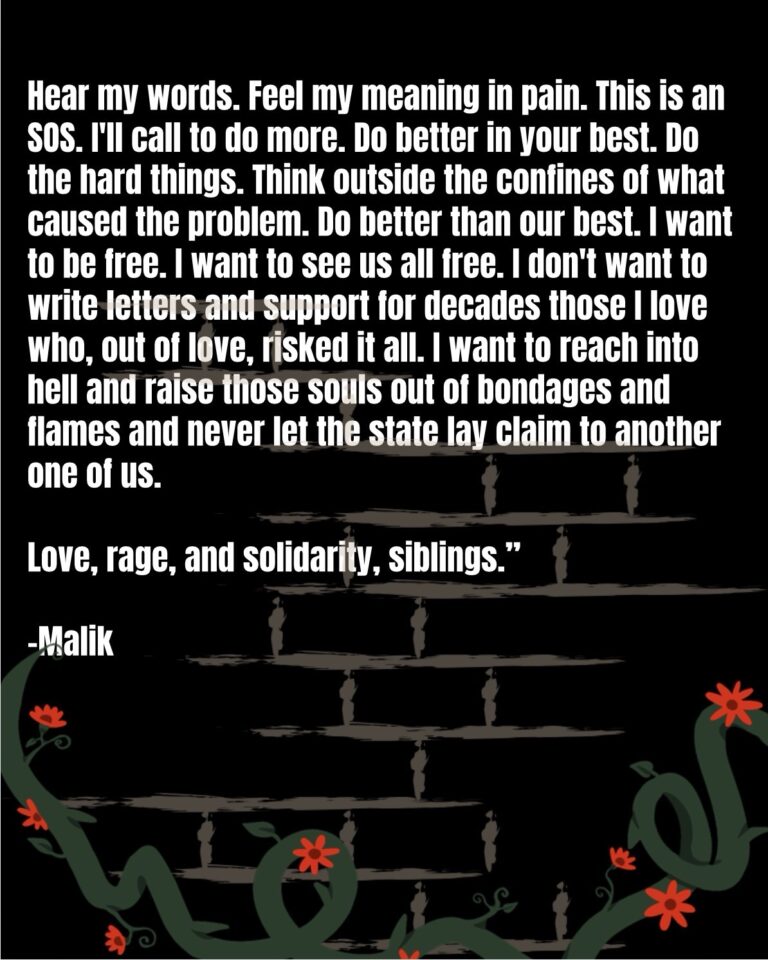
Hear my words. Feel my meaning in pain. This is an SOS. I’ll call to do more. Do better in your best. Do the hard things. Think outside the confines of what caused the problem. Do better than our best. I want to be free. I want to see us all free. I don’t want to write letters and support for decades those I love who, out of love, risked it all. I want to reach into hell and raise those souls out of bondages and flames and never let the state lay claim to another one of us.
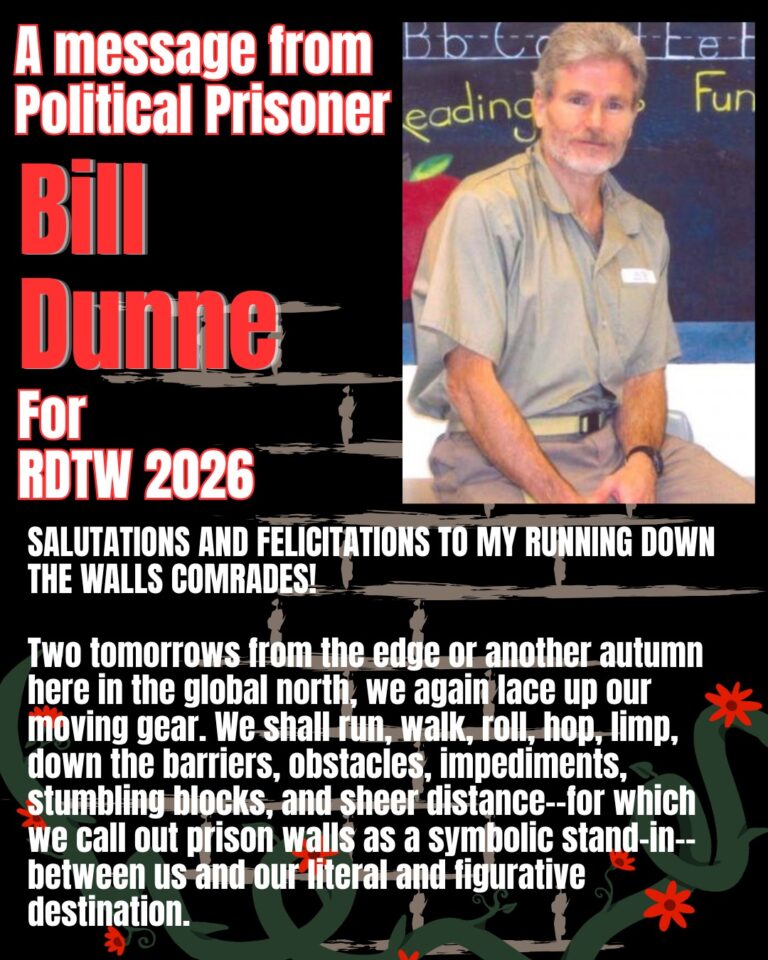
SALUTATIONS AND FELICITATIONS TO MY RUNNING DOWN THE WALLS COMRADES!
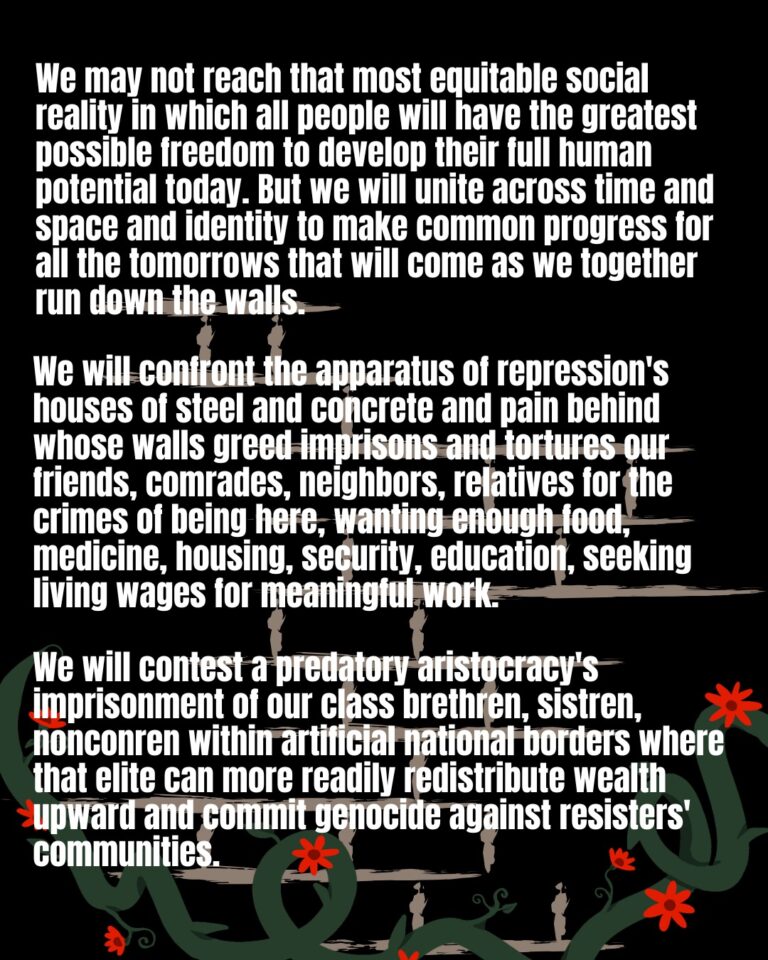
Two tomorrows from the edge or another autumn here in the global north, we again lace up our moving gear. We shall run, walk, roll, hop, limp, down the barriers, obstacles, impediments, stumbling blocks, and sheer distance–for which we call out prison walls as a symbolic stand-in–between us and our literal and figurative destination. We may not reach that most equitable social reality in which all people will have the greatest possible freedom to develop their full human potential today. But we will unite across time and space and identity to make common progress for all the tomorrows that will come as we together run down the walls.
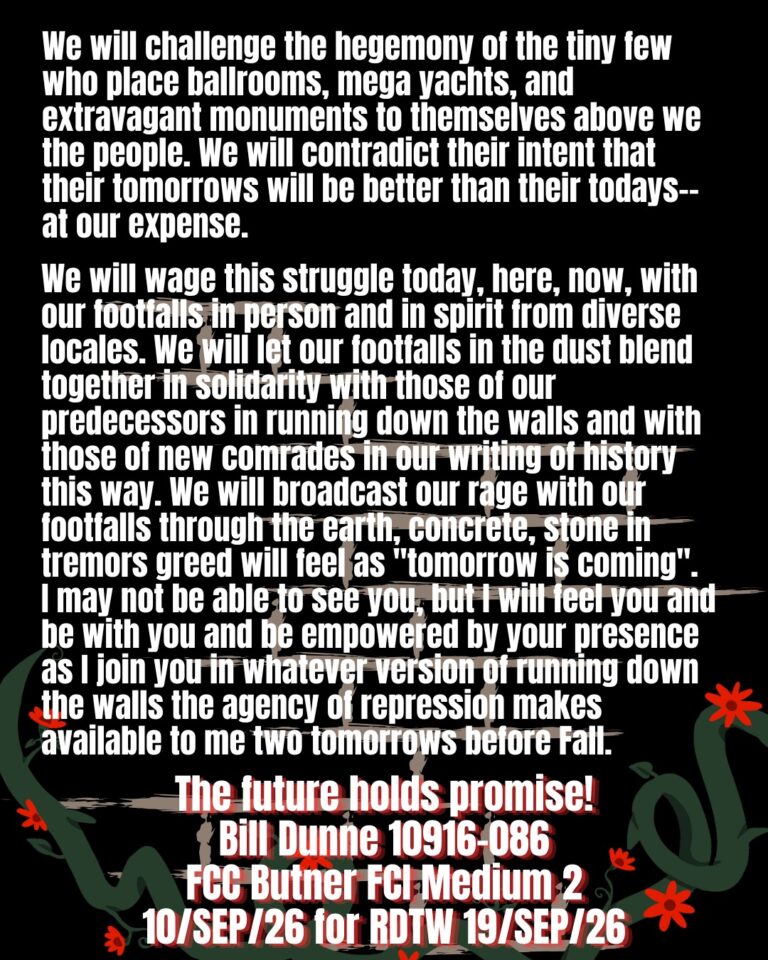
We will confront the apparatus of repression’s houses of steel and concrete and pain behind whose walls greed imprisons and tortures our friends, comrades, neighbors, relatives for the crimes of being here, wanting enough food, medicine, housing, security, education, seeking living wages for meaningful work. We will contest a predatory aristocracy’s imprisonment of our class brethren, sistren, nonconren within artificial national borders where that elite can more readily redistribute wealth upward and commit genocide against resisters’ communities. We will challenge the hegemony of the tiny few who place ballrooms, mega yachts, and extravagant monuments to themselves above we the people. We will contradict their intent that their tomorrows will be better than their todays–at our expense.
We will wage this struggle today, here, now, with our footfalls in person and in spirit from diverse locales. We will let our footfalls in the dust blend together in solidarity with those of our predecessors in running down the walls and with those of new comrades in our writing of history this way. We will broadcast our rage with our footfalls through the earth, concrete, stone in tremors greed will feel as “tomorrow is coming”.
I may not be able to see you, but I will feel you and be with you and be empowered by your presence as I join you in whatever version of running down the walls the agency of repression makes available to me two tomorrows before Fall.
The future holds promise! Bill Dunne 10916-086 FCC Butner FCI Medium 2