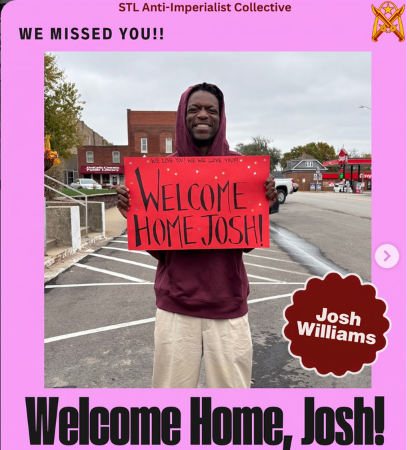
We are very thrilled to announce that Ferguson Political Prisoner, Josh Williams, has come home today! This has been a long 11 years being held captive by the state and we are so thankful that he’s finally out and back into community where he belongs.
We wanted to thank all of the groups and individuals that have supported Josh for all these years, this could not have been done without all of your support. We need to continue to support Josh through his transition and we can do so by donating to his re-entry funds and helping him pay off the fees associated with incarceration.
Josh also has another court date coming later in November, so please watch for any announcements regarding support that he might need!
NYC ABC, along with several other individuals and prisoner support crews, now send hard copies to all political prisoners and prisoners of war we support.
If you consistently mail the latest updates to a specific prisoner, please let us know so we can insure there’s no overlap. The goal is to have copies sent to all of the prisoners we list.
We’ve also been told that some prisoners are not receiving the copies sent in, yet we aren’t getting rejection notices. If you are in steady contact with a prisoner, please ask them whether or not they are receiving the updates and let us know.
More than five years have passed since January 6, 2021, a date forever linked with one of the most divisive moments in modern American history.
by Don Ritter (The Saratogian)
While the nation’s attention focused on the attack on the United States Capitol in Washington, D.C., another violent confrontation unfolded hundreds of miles away outside the New York State Capitol in Albany during a “Stop the Steal” rally. It was there that Albany resident Alex Contompasis became involved in a violent altercation that ultimately resulted in his conviction and a lengthy prison sentence.
Today, a striking contradiction exists. Nearly all of the individuals convicted of federal crimes arising from the January 6 events at the U.S. Capitol have been released after President Donald Trump issued sweeping pardons and commutations in January 2025. Yet Alex Contompasis remains incarcerated in New York State.
Whether one agrees with his politics is not the issue. The real question is whether justice has been served and whether executive clemency is appropriate. Supporters argue that Contompasis believed he was defending himself and others during a rapidly escalating confrontation involving members of the Proud Boys and counter-protesters. They contend that the circumstances were chaotic, emotions were high, and decisions had to be made in seconds rather than after hours of legal analysis. Advocates have continued to campaign for clemency, arguing that his sentence is disproportionate and that his case raises broader questions about New York’s self-defense laws.
The courts, however, viewed the evidence differently. An Albany County jury convicted Contompasis, and in 2025, the Appellate Division unanimously upheld his conviction, concluding that the evidence supported the verdict and rejecting his self-defense arguments. Still, executive clemency exists precisely because the legal system recognizes that mercy may sometimes be appropriate even after a lawful conviction.One of the strongest arguments for clemency is consistency. The federal government chose to extend extraordinary mercy to those convicted of offenses connected to the January 6 attack on the U.S. Capitol, including individuals convicted of assaulting police officers and other serious crimes. Whether one
supported or opposed those pardons, they fundamentally changed the landscape of January 6 justice. Against that backdrop, Contompasis’ continued imprisonment appears, to many observers, increasingly difficult to reconcile. Executive clemency is not a declaration that someone was legally innocent. It is an acknowledgment that mercy, fairness, rehabilitation, or broader public interests justify reducing or ending a sentence. Governors and presidents have exercised this authority throughout American history.
New York Governor Kathy Hochul has granted numerous pardons and commutations during her administration after reviewing evidence of rehabilitation and other equitable considerations. If executive clemency is intended to recognize cases deserving individualized consideration, then supporters argue that
Alex Contompasis deserves that consideration as well.Reasonable people can disagree about what happened outside the State Capitol that day. They can disagree about whether Contompasis acted reasonably, whether he overreacted, or whether the jury reached the correct verdict. Those debates will likely continue for years. But clemency is not about retrying a criminal
case. Instead, it asks whether continued imprisonment still serves the interests of justice.If New York believes in redemption, proportionality, and individualized review, then Contompasis’ petition deserves careful consideration. His supporters argue that enough time has passed, that he no longer presents a danger to society, and that continued incarceration accomplishes little beyond extending punishment.
Others will disagree and believe the seriousness of the assault warrants completion of the sentence.
Ultimately, clemency is an act of executive judgment, not judicial review. It allows elected leaders to balance justice with mercy when extraordinary circumstances warrant. Whether Governor Hochul ultimately agrees is her decision alone. Under New York law, she has constitutional authority to grant pardons and commutations after reviewing the facts of each individual case.As New York continues to reflect on the divisions exposed on January 6, it may also be time to ask whether mercy has been applied consistently. If nearly every federally convicted January 6 defendant has now received clemency or release, supporters argue that Alex Contompasis should at least receive the same careful consideration under New York’s clemency process. I have known Alex since he was a young man, and I have known the family for more than 50 years, a family that has contributed to the arts and business community of Albany. This was not some out-of-state radical who came to Albany to start trouble.
Justice should always be even-handed. Mercy should not depend solely on which government prosecuted the case or on the politics surrounding it. Regardless of one’s view of Alex Contompasis, his application for executive clemency deserves a thorough, fair, and impartial review.
Is this an American Justice System or an American Injustice System?
NYC ABC, along with several other individuals and prisoner support crews, now send hard copies to all political prisoners and prisoners of war we support.
If you consistently mail the latest updates to a specific prisoner, please let us know so we can insure there’s no overlap. The goal is to have copies sent to all of the prisoners we list.
We’ve also been told that some prisoners are not receiving the copies sent in, yet we aren’t getting rejection notices. If you are in steady contact with a prisoner, please ask them whether or not they are receiving the updates and let us know.
Casey offers here their reflections on the recent book drive they organized for the prison library, its popularity with everyone locked up, as well as how it has since been blocked and how Casey subsequently was fired from their library job. Please share and repost. – Casey Support Committee
AFFIRMATION
Thank you to everyone out in the so-called “free world” for contributing to our Summer Book Drive. On behalf of the Support Committee and every convict at FCI Allenwood Medium involved in this autonomous initiative, we send our revolutionary love and profound gratitude. From this self-organized prisoner initiative, we introduced a wide range of new, interesting, and relevant books into the prison’s official library collection. During my time as a library worker, many significant changes were made to the form and content of the library here at Allenwood Medium. Unfortunately, because of the Book Drive’s budding success and overwhelming popularity among the captives, i was fired from my job as librarian last week.
TERMINATION
On Thursday, October 1, i was fired as a library worker at FCI Allenwood Medium prison for no reason other than “ordering too many books” and “donating them directly into the library catalog” without the approval of the Education Department Supervisor, Mr. Williams. Although my boss, Ms. Ashton, knew about the plans for a mass donation and granted permission to do so, i was thrown under the bus once she learned her boss found out, and especially once she learned i was adding certain books into the catalog without her approval. There is nothing against policy within the books that were donated, even the ones i donated without Ms. Ashton’s knowledge. The Book Drive was successful in adding around one hundred brand new books to the library catalog, which transformed the library space from a realm of entertainment and distraction into one of pedagogy and critical study. By the first week of September, around seventy more books were delivered to the mailroom, yet staff deliberately let them pile up, before complaining to admin about the quantity of donations and returning them all back to sender. A few days later i learned of my termination.
It’s the overwhelming pettiness of the reaction that bothers me. There is no BOP policy that states we as prisoners cannot donate books into the library collection. There is an official process to do so however and i bypassed some of the red tape. Yet the only violation of policy i am “guilty” of is not showing my boss, Ms. Ashton, every single book that i was donating. My decision to not report donations wasn’t at all due to any intentional plot of deception. It was simply because whenever i gave my donations to Ms. Ashton, she would “never get around” to adding them into the catalog. They would just sit around and often disappear. I was frustrated by Ashton’s lack of enthusiasm regarding this rare opportunity to enhance the library collection, so i decided to just start marking, labeling, and cataloging the books myself. Basic direct action.
ACTION/REACTION
All who were involved in the Summer Book Drive (not only me as an individual) took direct action both to remedy the negligence of the correctional officers who oversee “education” operations at Allenwood Medium and to counter fascist anti-intellectualism, of which the official indifference to our depraved learning conditions is symptomatic. I am not exactly sure how the process occurred behind the scenes, but apparently a mailroom officer (who does not like me) contacted S.I.S. (the surveillance and investigative wing of the prison administration), who then contacted Mr. Williams, who in turn emailed Ms. Ashton ordering my termination as a library employee. I believe that the primary reason i was fired was politically motivated censorship, coupled with the fact that some of the COs already had an issue with me working in the library.
My termination as a library worker demonstrates how the administration at FCI Allenwood Medium will attempt to stifle any act of autonomous sufficiency and self-organization among us convicts, especially if activities aim to improve the conditions of life. The Summer Book Drive initiative was not only an attempt to counter the dehumanizing conditions of a neglectful Education Department but a demonstration of collective action to provide and (re)distribute resources in the face of (or rather in spite of) organized abandonment. Inadvertently, the initiative also illuminated a potential collective capacity that exists between concrete people across prison walls. Within a matter of weeks around 200 books were donated through a public wishlist. What other outcomes might result from a similar constellation of autonomous, informal organization? The purpose of this reportback, however, is not to address this question in particular. That must be the topic of discussion elsewhere. For now, i just want to catch everyone up to speed and explain just how the Summer Book Drive unfolded, and how our work in the library was demonstrably changing the atmosphere of learning in this prison.
REPORTBACK
When i arrived at FCI Allenwood Medium back in February, i was appalled by the lack of resources provided by the Education Department’s “library.” Barely any of the books were visible on the shelves. The shelves themselves were behind a desk, so no patrons could walk up and pull a book on their own. The content of the library catalog was almost entirely fiction, and none of the scarce non-fiction texts were visible at all. In fact, i was told by my boss Ms. Ashton that “this bunch are more of the fiction, fantasy kind of guys” — an assumption proven completely false once i conducted a survey and began offering fellow prisoners non-fiction books with social, cultural, and historical relevance. From what i’ve gathered, the library at Allenwood Medium is by far one of the worst libraries in the Federal BOP. The more time i spent in the library, i became intimately attentive to the inadequacies and intricacies of why this alleged library earned the reputation of “worst of the worst.”
In June 2026, when i was hired as a librarian, i began conducting a survey of each “car” in my unit and then across the entire compound, researching what the most popular books are among prisoners at Allenwood Medium. (For those who don’t know, “cars” are how we are collectively organized, prisoner-to-prisoner throughout the BOP; i.e. the Midwest Car, White Car, Gang Cars, Pennsylvania Car, and so on.) I made sure that all races and religious affiliations were considered in this survey, and i consolidated the results to a list of around 100 specific books, as well as dozens of authors, publishers, and topics of books that prisoners desired to read at this facility. From there my support committee and i created a wishlist derived from the survey findings and circulated the wishlist publicly using the incredible www dot bookshop dot org. The idea was to use the social platform that my support committee has worked so hard to maintain over the past two and a half years to organize a SUMMER BOOK DRIVE, where people on the outside can purchase the requested books from the public wishlist. The books then were to be delivered to me, which i would donate directly into the library collection.
As the Book Drive began, i was already involved in the process of rearranging the library stacks by subject and genre and had the support of Ms. Ashton to do this. In fact, she initially welcomed my consistency and enthusiasm. For FICTION i divided up the shelves to hold (with visible labels) ‘Fantasy’, ‘Western’, ‘Science Fiction’, ‘Thriller & Suspense’; ‘Mystery & Crime Drama’, ‘Deep State Fiction & Political Drama’, ‘Military Fiction’, ‘Historical Fiction (Modern)’, ‘Historical Fiction (Pre-Modern)’, ‘Historical Fiction (20th Century)’. As time went on my plan was to also create an section of the library for ‘Urban Novels’ and ‘African American Classics’. For NON-FICTION, i made the existing books in the library visible to patrons for the FIRST TIME EVER and then created various subject categories such as ‘US History (Pre-20th Century)’, ‘US History (20th-21st Century)’, ‘World History’, ‘Social Studies’, ‘Native Studies’, ‘Science & Nature’, ‘Geography’, ‘Music, Film, & Pop Culture’, ‘Sports’, ‘Health & Fitness’, ‘Business & Marketing’, ‘Self-Help’, ‘Survival & Uplift’, and ‘Resume & Job Search Resources’.
As i described above, around 100 books were successfully delivered to me. After receiving what books the mailroom *did* allow, i added those books into the library catalog. By “adding into the catalog,” i mean that my coworkers and i stamped, stickered, added check-out cards in the books, and shelved them. The feedback from fellow convicts regarding the Book Drive was wildly supportive and positive without a doubt. As the library collection progressed, regular patrons who entered the library would comment on how much better the selections were; how much easier it was to find books; how they felt more interested in going to the library; and most of all, i noticed a substantial interest in the non-fiction sections, especially Social Studies, US History, and Native Studies. The number of nonfiction books that patrons checked out increased markedly. Most importantly, in the days leading up to my termination, a new spirit of critical study and discussion seemed to be permeating the library and its users.
I have to remind myself that there is only so much you can do without greater organization of opposition to the prison regime from within and without. I am chalking this up as another experience, or maybe, rather, the marking of a new chapter in the Campaign Against Prison Censorship and Book Banning [ see https://trueleappress.wordpress.com/2023/04/13/new-zine-campaign-against-prison-censorship-and-book-banning/ ]. I’m not sure what my next moves will be, but one thing is for certain: There’s a growing number of convicts in this prison who desire a deeper grasp of the world beyond the false sense of “participation” shoved upon us by the TV screens, corporate newspapers, radio shows, remedial programs, and commercial-distraction novels sanctioned by the Federal Bureau of Prisons. The Book Drive could be blocked but the information that such literature instills in our convict class is something that fascists can never return to sender. One idea that my celly had was to simply order books on anti-prison activism, abolition, and prisoner movement history for every prisoner at FCI Allenwood Medium. All of our information is public access on the BOP website. Just pick a name on the BOP “Inmate Locator” and order a book. Brilliant!
Ever more obvious is the substantial mass of people beyond the wall in the so-called “free world” who are impacted by the regime and continue to express a desire to participate in collective anti-prison resistance. These are people actively searching for opportunities to support their own loved ones and others in captivity. As Ruth Wilson Gilmore writes in her 1999 article ‘You Have Dislodged a Boulder’, by “organizing surplus labor into cages,” the state pulls our loved ones, especially mothers and other caregivers, into its “spheres of operation.” The regime’s gravitational pull on our families and communities creates opportunities where our people can find each other and cooperate together *against* the state’s interests. Gilmore writes, “The magnitude of imprisonment suggests the magnitude of possibility”; and that magnitude “starts small, over and over again.” The scale and dynamic capacity of formal and informal prisoner-support structures put on display by the Summer Book Drive suggests the embryo of such possibility. I know if i were on the outside right now, i would be dreaming and scheming of where to take this collectivity next. I send my blessing for anyone reading this to do the same. After all, it’s one struggle at base.
To write Casey: Casey Goonan #24611-511 FCI Allenwood Medium PO BOX 2000 White Deer, PA 17887
On July 4th, during a protest at the Prairieland Detention Center in Alvarado, Tx Maricela Rueda was arrested for speaking out against the injustices of the immigrant detention system. She is currently incarcerated for taking a courageous stand in defense of dignity and justice. Maricela has always been a tireless advocate for human rights. Maricela is a mother, a daughter, a sister, and a loyal friend. Her arrest has left her family facing sudden and overwhelming challenges. Maricela’s young daughter is now without her mother’s daily love and care, and her family must also manage her estate and responsibilities while navigating the uncertainty ahead. We are asking for your support to help ease the financial strain during this heartbreaking time. All funds will go directly toward caring for her daughter and managing the urgent needs of her household. Thank you for standing in solidarity with Maricela and those who love her.
We’ve finished the latest version of the NYC ABC “Illustrated Guide to Political Prisoners and Prisoners of War” and it’s available for viewing (and download) by clicking on the link below.
This update includes updated mini-bios, illustrations, and address changes for several prisoners. Unfortunately, this edition adds four of the non-cooperating Prairieland defendants–Rowan Gibson, Autumn Hill, Mari Rueda, and Champagne Song.
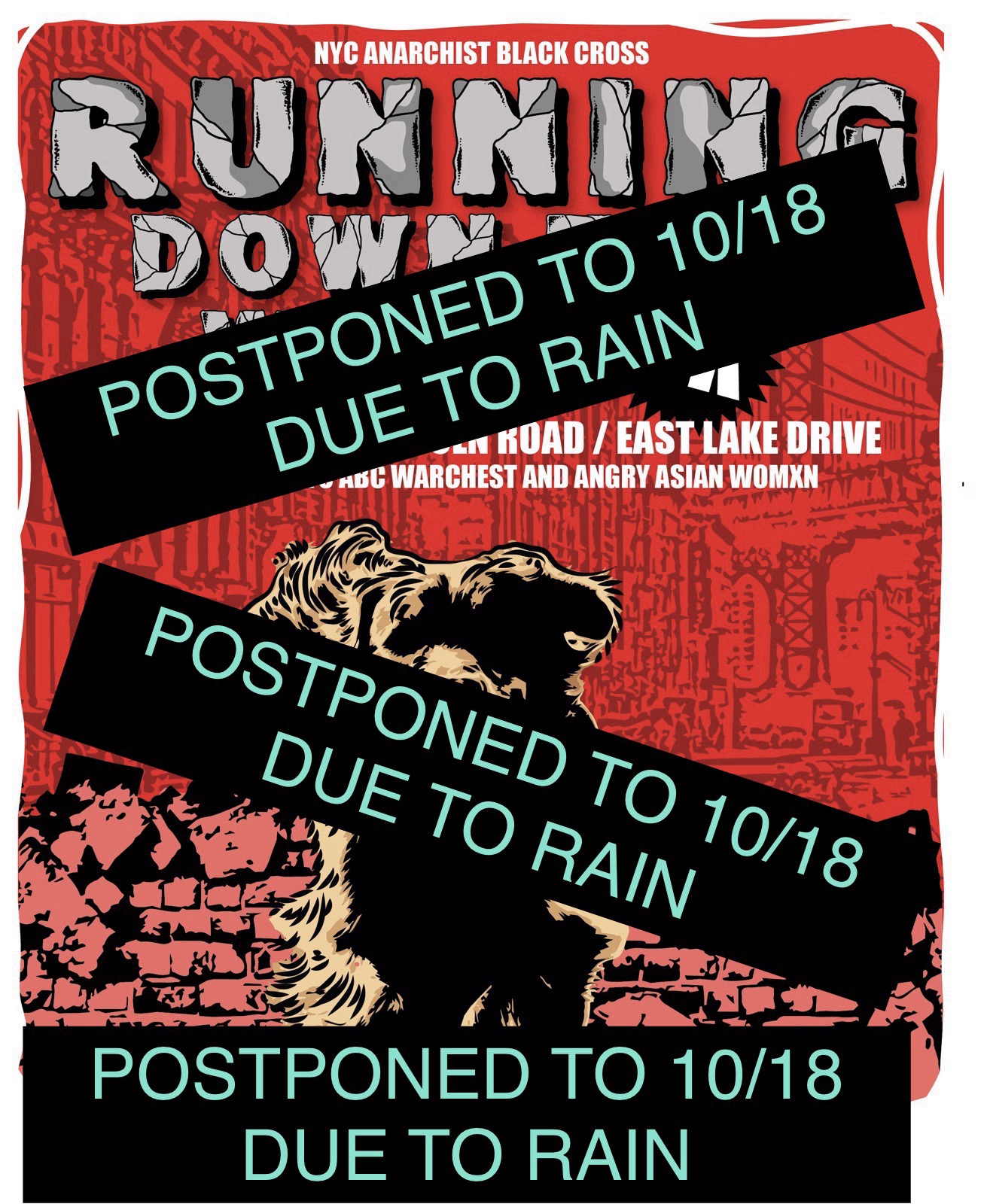
The agency of repression closed the yard for my contribution to RDTW, this weekend before the fall, 2026. The passage of time is revealing a rift between the concrete paving the small courtyards that remained open and the knees. The hamstrings and the ridiculously curved treadmills have a similar schism. So I rode an elliptical into the fray to Run Down the Walls. I let ’em have both legs three days and then again two days before the fall, 19 & 20 September. I had to do some slithering to access the venue the second day, but so it goes in life with big brother And the day before the fall, I write this report. Plus, I may have added one more means of motion to run down the walls: rowing. After my engagements on the ellipticals had ended, I wrestled the rowing machine to wring a few more gritty grains from the walls.
As my feet pushed ever forward and my arms aided and abetted, the elliptical didn’t carry me any where but figuratively. My forced presence in that physical moment, however, let me, made me, invited me me to notice the little drops of sweat hitting the concrete floor as they dripped off me. At first, just a few isolated individuals dotted the scuzzy gym floor–literal drops in the bucket, but without even a bucket. But the drops started coming in numbers, and their dots started running into each other. They started making bigger splats together than by themselves. They started to run together into a puddle. Not much of a puddle, but a puddle. Tiny ripples started to appear–and what is a ripple but a baby wave? Making waves in a social order like ours is always good. Some drops hitting the nascent puddle launched diminutive splashes, maybe reaching as far as the wall, where some of them eroded and ran off with some molecules of wall. Best of all, drops and splats and small ripples from the guy sweating on the next machine started running together with mine. Don’t know where he came from. Don’t know what car he rode in. But he was throwing down some work for a better future like I was. And our collective drops of sweat were conquering the entire floor.
May your Fall be a season of of connection, progress, and feeling good!
The future holds promise!
Bill Dunne 21 September 2026
Bill Dunne #10916 086 FCI Butner Medium II Post Office Box 1500 Butner, North Carolina 27509
Hey y’all, my name is Champagne. I was sentenced this year to 100 years for, in the words of the government “[being] the embodiment of Antifa.” Before my sentencing, I spoke the truth clearly and refused to be interrupted in court. I am not afraid. Even as violence rises all around me both inside and outside these walls. I am not afraid because the struggle remains the same. The great disasters and failures we face remain the same.
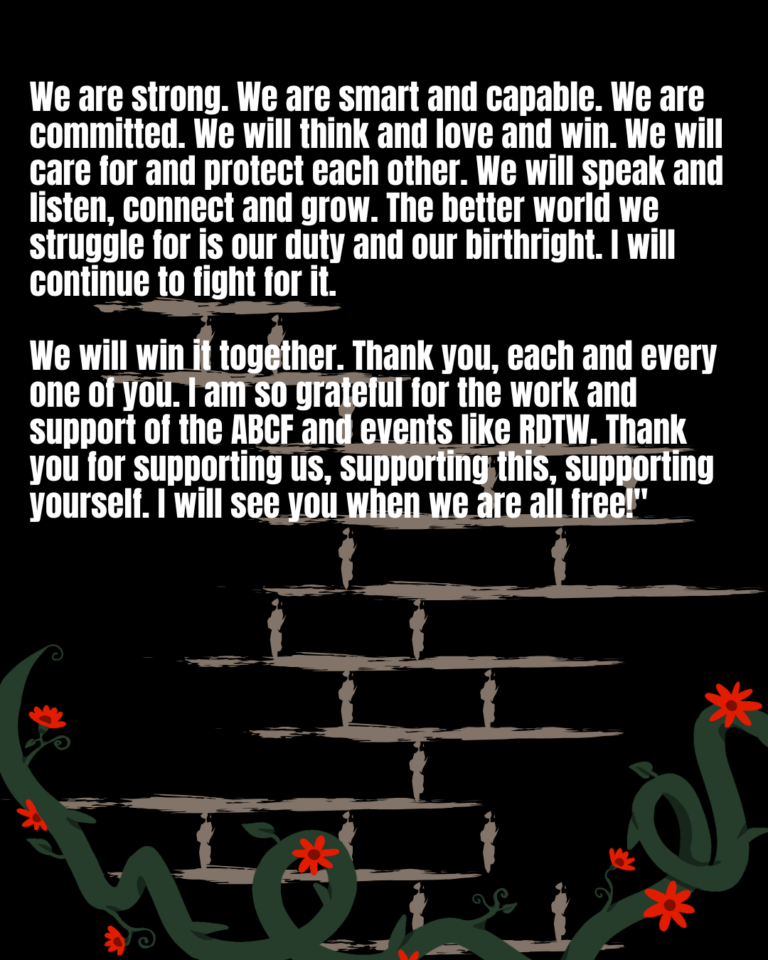
Our duty, as Assata told us, remains the same. I know I am just one in a sea of us. We are strong. We are smart and capable. We are committed. We will think and love and win. We will care for and protect each other. We will speak and listen, connect and grow. The better world we struggle for is our duty and our birthright. I will continue to fight for it. We will win it together. Thank you, each and every one of you. I am so grateful for the work and support of the ABCF and events like RDTW. Thank you for supporting us, supporting this, supporting yourself. I will see you when we are all free!